
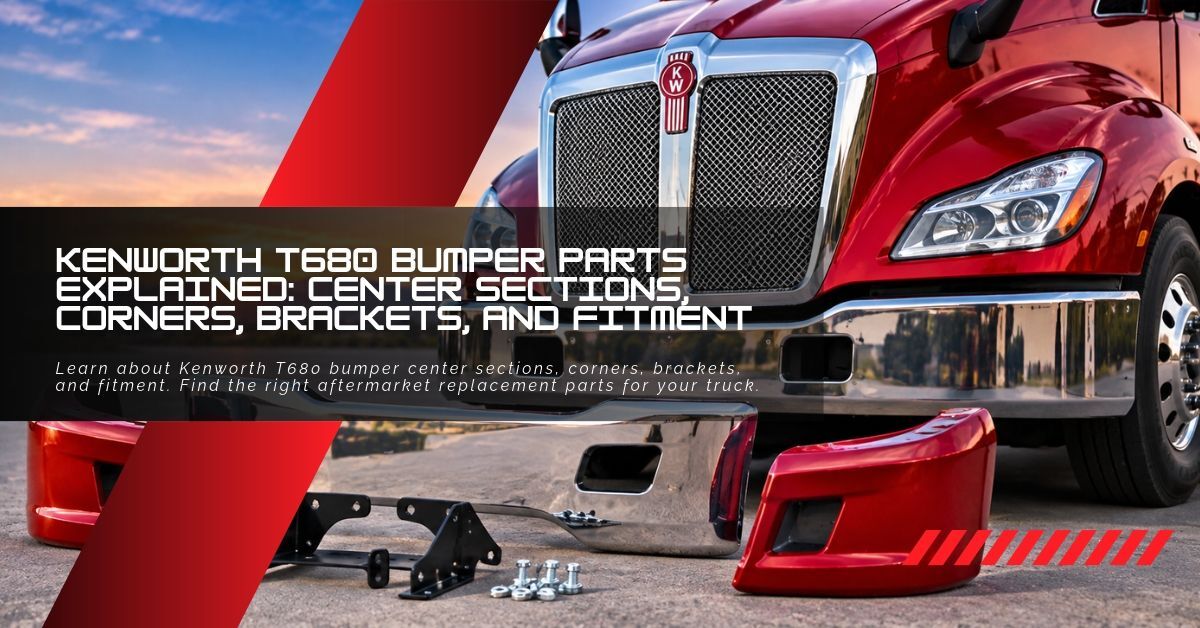
A damaged bumper on a Kenworth T680 does not always mean the entire front bumper assembly needs to be replaced. Depending on the model year, bumper configuration, and extent of the damage, truck owners may be able to replace individual components instead of purchasing a complete assembly.
However, identifying the correct Kenworth T680 bumper parts can be more complicated than it initially appears.
Front bumper assemblies may include multiple sections, mounting brackets, support hardware, and openings for lighting or other equipment. Even when replacement components look similar, differences in design and fitment can affect installation.
For independent drivers, fleet managers, and maintenance technicians, understanding these differences is essential when shopping for semi truck parts.
This guide explains the major components of a Kenworth T680 bumper assembly, how to identify the correct replacement parts, and what to verify before placing an order.
Understanding the Kenworth T680 Front Bumper Assembly
The Kenworth T680 is a popular highway tractor designed for commercial transportation. Its front-end components contribute to the truck's appearance, aerodynamics, and protection of certain components behind the bumper.
Although the exact design varies by model year and configuration, a T680 bumper assembly may consist of several separate parts.
These can include:
- Center bumper sections
- Left and right bumper corners
- Mounting brackets
- Reinforcement or support components
- Lower trim or aerodynamic panels
- Fasteners and attachment hardware
- Openings or provisions for compatible lighting and equipment
Not every Kenworth T680 uses the same bumper arrangement. The specific parts required depend on the truck's configuration.
This is why identifying the damaged component is the first step before ordering a replacement.
1. Kenworth T680 Center Bumper Sections
The center section is one of the most visible components of the front bumper assembly.
Depending on the truck's design, it may be a separate replacement component or part of a larger bumper assembly.
What Does the Center Bumper Section Do?
The center section helps form the front bumper's exterior structure and appearance.
It may also provide attachment points for surrounding bumper components or trim.
Its exact construction and function depend on the vehicle's bumper design.
Common Signs of Center Bumper Damage
Truck owners should inspect the center section for:
- Visible cracks
- Deformation or warping
- Broken mounting tabs
- Loose attachment points
- Misalignment with surrounding bumper sections
- Damage caused by road debris or minor impacts
A cracked center section may sometimes be replaceable without changing the entire bumper assembly.
However, the supporting brackets and surrounding components should also be inspected.
If an impact has damaged the bumper's structural support, replacing only the visible exterior panel may not address the underlying problem.
What to Check Before Ordering
When selecting a center bumper replacement, confirm:
- Kenworth T680 model year
- Applicable bumper configuration
- Original part number, if available
- Dimensions and mounting locations
- Compatibility with existing bumper corners
- Finish and material specifications
These details help ensure the replacement fits correctly.
2. Kenworth T680 Bumper Corners: Left vs. Right
Bumper corners are particularly vulnerable to damage because of their location near the outer edges of the truck.
They may experience contact with curbs, loading dock obstacles, debris, or other objects during maneuvering.
On bumper designs with separately replaceable corners, replacing the damaged side may be more practical than replacing the entire assembly.
Driver-Side Bumper Corners
The driver-side corner is generally located on the left side of the vehicle when viewed from the driver's seated position.
This distinction matters because parts listings may use terms such as left-hand, LH, driver-side, or front-left.
Always confirm the supplier's orientation convention before ordering.
Passenger-Side Bumper Corners
Passenger-side bumper corners are typically identified as right-hand or RH components.
Although left and right bumper corners may look similar, they are not necessarily interchangeable.
Their mounting tabs, contours, and attachment locations may differ.
Common Bumper Corner Problems
Look for:
- Cracks near mounting points
- Broken attachment tabs
- Missing fasteners
- Loose or hanging corner sections
- Gaps between the bumper corner and center section
- Damage to adjacent trim or lighting components
When replacing a bumper corner, compare the original part with the replacement's shape and attachment points.
An incorrectly matched corner can create uneven panel gaps or installation difficulties.
3. Why Kenworth T680 Bumper Brackets Matter
Bumper brackets are sometimes overlooked because they are less visible than the exterior bumper panels.
However, they play an important role in supporting and positioning the bumper assembly.
A replacement bumper section may not fit correctly if the underlying bracket is bent or damaged.
Signs of Damaged Bumper Brackets
Possible warning signs include:
- Bumper sections sitting unevenly
- Visible gaps between panels
- Loose bumper components
- Difficulty aligning mounting holes
- Cracked or bent support hardware
- Unusual movement or vibration
A bumper that appears crooked after a minor impact may have damage beneath the visible surface.
Simply installing a new exterior panel will not necessarily correct the alignment.
Should You Replace the Brackets With the Bumper?
Not every bumper replacement requires new brackets.
If the original mounting hardware is undamaged and remains compatible with the replacement, it may be reusable according to the applicable service instructions.
However, damaged brackets, deformed fasteners, or compromised mounting points should be addressed during the repair.
For fleet maintenance teams, inspecting these components before ordering can help avoid delays caused by discovering additional damage during installation.
4. Lower Bumper Panels and Aerodynamic Components
Modern highway tractors often use aerodynamic features to help manage airflow around the vehicle.
Depending on the Kenworth T680's configuration, lower bumper components and surrounding panels may contribute to the truck's aerodynamic design.
These parts can be exposed to road debris, curbs, and uneven surfaces.
What Happens When Lower Panels Are Damaged?
Possible issues include:
- Loose or hanging panels
- Broken mounting points
- Increased vibration
- Misalignment with adjacent body components
- Loss of the panel's intended aerodynamic function
Not every damaged lower panel requires a complete bumper replacement.
The appropriate repair depends on whether the component is separately available and whether surrounding attachment points remain intact.
When comparing aftermarket semi truck parts, verify whether lower trim pieces are included with the bumper assembly or sold separately.
This distinction can affect both the total cost and the parts needed for installation.
5. Kenworth T680 Bumper Fitment: Why Model Year Matters
One of the most common mistakes when ordering truck body components is assuming that all parts for a particular model are interchangeable.
The Kenworth T680 has been produced in different configurations and generations.
Changes in exterior styling, bumper construction, mounting arrangements, and associated equipment can affect compatibility.
Original T680 vs. Newer T680 Configurations
An earlier T680 bumper may not fit a newer-generation T680.
Even within a model generation, differences in equipment or production specifications may affect which replacement parts are appropriate.
Before purchasing, confirm the exact vehicle configuration rather than relying only on the name "Kenworth T680."
Use the Original Part Number When Possible
The original equipment part number can be one of the most useful references when identifying a replacement.
If the original part number is unavailable, compare the truck's VIN and applicable configuration information with the supplier's fitment details.
Photographs and measurements can provide additional confirmation, but they should not replace model-specific compatibility information.
Check for Equipment Differences
Depending on the truck, bumper configurations may differ in their provisions for:
- Fog lights or other exterior lighting
- Mounting brackets
- Lower trim panels
- Aerodynamic components
- Sensors or other installed equipment
A bumper that fits physically may still be unsuitable if it does not accommodate the truck's original equipment.
This is particularly important when replacing components on trucks with integrated safety or driver-assistance systems.
6. Should You Replace One Bumper Component or the Entire Assembly?
A damaged bumper does not automatically require a complete replacement.
However, replacing individual components is only practical when the affected parts are separately available and the remaining assembly is in suitable condition.
When Individual Component Replacement May Make Sense
Replacing a single bumper section may be appropriate when:
- Damage is limited to one replaceable component
- Adjacent sections remain intact
- Mounting brackets are undamaged
- The replacement is compatible with the existing assembly
- The repair follows the applicable vehicle service requirements
For example, a cracked bumper corner may be replaceable independently if the supporting hardware and center section remain undamaged.
When a Complete Assembly May Be Necessary
A full bumper replacement may be more appropriate when:
- Multiple sections are damaged
- The assembly is severely deformed
- Mounting points are compromised
- Individual components are unavailable
- The required repair cannot restore proper fitment
- The applicable repair procedure requires assembly replacement
The decision should account for the condition of the entire bumper system, not just the visible damage.
7. OEM vs. Aftermarket Kenworth T680 Bumper Parts
Truck owners often compare OEM replacement components with aftermarket alternatives.
Both options can be appropriate when the parts meet the vehicle's requirements.
OEM Kenworth Bumper Parts
OEM components are specified for particular vehicle applications.
They may be preferred when maintaining the original design, finish, or equipment configuration is a priority.
However, availability and pricing can vary.
Aftermarket Kenworth Bumper Parts
Quality aftermarket semi truck parts can offer additional replacement choices for truck owners and fleet operators.
Depending on the product, aftermarket bumper components may provide competitive pricing and suitable alternatives to original equipment.
However, the lowest-priced option is not necessarily the best value.
Before purchasing, compare:
- Fitment specifications
- Material and construction quality
- Mounting compatibility
- Included hardware
- Finish and appearance
- Warranty information
- Supplier return policies
The right replacement should fit securely and meet the requirements of the truck's configuration.
For related information about front-end components, QSC Truck Parts also discusses why Kenworth T680 headlights and bumper upgrades matter.
While that article focuses on upgrades, understanding the individual components is equally important when planning a repair.
8. Common Mistakes When Ordering Kenworth T680 Bumper Parts
Incorrect replacement orders can increase downtime and create unnecessary expenses.
Here are several mistakes truck owners should avoid.
Mistake 1: Ordering by Truck Model Alone
Knowing that a vehicle is a Kenworth T680 is not always enough.
Confirm the model year, generation, and relevant configuration.
Mistake 2: Confusing Left and Right Bumper Corners
Driver-side and passenger-side components may use different mounting arrangements.
Always verify the correct side.
Mistake 3: Ignoring Hidden Bracket Damage
A replacement panel may not align properly if the mounting bracket is bent.
Inspect the hardware before ordering.
Mistake 4: Assuming All Hardware Is Included
Some replacement components may be sold without mounting brackets, fasteners, or related trim.
Review the product description carefully.
Mistake 5: Choosing Parts Based Only on Photos
Product photos are useful, but they may not show every mounting point or configuration difference.
Use part numbers and fitment information whenever possible.
Mistake 6: Overlooking Lighting and Equipment Compatibility
If the original bumper includes openings or mounting provisions for specific equipment, the replacement must accommodate those features.
Avoiding these mistakes can make the repair process more efficient and help prevent repeated orders.
9. Finding Kenworth T680 Bumper Parts and Semi Truck Parts in Orange County
Commercial truck operators throughout Southern California depend on reliable replacement parts to keep their vehicles operating.
For truck owners searching for semi truck parts Orange County, accurate product information is particularly important when ordering model-specific body components.
A supplier should provide enough information to help buyers identify the appropriate replacement.
Useful product details include:
- Compatible truck models and production years
- Part numbers
- Left-hand or right-hand designation
- Material specifications
- Included components
- Mounting requirements
- Product photographs
- Shipping and return information
QSC Truck Parts offers an online selection of semi truck parts for various commercial truck makes and models.
Truck owners looking for replacement components can also explore the available Kenworth T680 bumper category and compare product listings against their vehicle specifications.
When ordering aftermarket parts, confirming compatibility before purchasing can help reduce unnecessary delays.
10. How Fleet Managers Can Simplify Bumper Replacement Orders
Fleet maintenance teams may manage multiple trucks with different production years and configurations.
Even when several vehicles belong to the same model family, they may not use identical bumper components.
Maintaining accurate vehicle records can simplify the ordering process.
Useful information to record includes:
- Vehicle identification number
- Model year and configuration
- Original bumper part numbers
- Replacement part numbers previously used
- Commonly damaged components
- Approved suppliers
- Maintenance and repair history
For fleets that frequently replace bumper corners or lower panels, tracking these details can help identify recurring maintenance needs.
It can also make future orders more efficient by reducing uncertainty about compatibility.
For broader maintenance planning, QSC Truck Parts' article on 10 exterior truck parts drivers should inspect every week provides additional inspection guidance.
Frequently Asked Questions About Kenworth T680 Bumper Parts
Are all Kenworth T680 bumpers interchangeable?
No. Compatibility can vary by model year, vehicle generation, bumper design, and equipment configuration. Always verify the correct part before ordering.
Can I replace only one Kenworth T680 bumper corner?
On configurations with separately replaceable bumper corners, an individual corner may be replaced if the remaining components and mounting hardware are undamaged and the repair is appropriate.
How do I know if my bumper brackets are damaged?
Possible signs include uneven bumper alignment, loose sections, visible bending, and mounting holes that no longer align correctly. Hidden damage may require closer inspection.
What is the difference between a bumper center section and a bumper corner?
The center section forms the middle portion of the bumper, while the corners are positioned toward the outer edges. Their exact design and whether they are separately replaceable depend on the truck's configuration.
Do aftermarket Kenworth T680 bumper parts fit like OEM parts?
Fitment varies by manufacturer and product. Quality aftermarket components should be selected using accurate vehicle compatibility information and appropriate specifications.
Does a replacement bumper include mounting brackets?
Not always. Some products include only the exterior bumper component, while others may include additional hardware. Review the listing to confirm what is included.
What information should I have before ordering a Kenworth T680 bumper?
Have the truck's model year, VIN or relevant configuration details, original part number if available, the damaged component's location, and information about any integrated equipment.
Final Thoughts: Order the Right Kenworth T680 Bumper Parts the First Time
Understanding the different components of a Kenworth T680 bumper can help truck owners make better replacement decisions.
Center sections, bumper corners, mounting brackets, and lower panels may require different replacement approaches depending on the vehicle's configuration and the extent of the damage.
Before ordering, confirm the truck's model year, original part specifications, mounting requirements, and any equipment compatibility considerations.
Whether you're replacing a single bumper corner or planning a more extensive front-end repair, choosing compatible aftermarket semi truck parts can help reduce ordering mistakes and unnecessary downtime.
Explore Kenworth T680 bumper replacement parts at QSC Truck Parts to compare available components and find the appropriate replacement for your truck.
With accurate fitment information and the right replacement parts, drivers and fleet maintenance teams can complete repairs more efficiently and keep their trucks ready for the road.
