
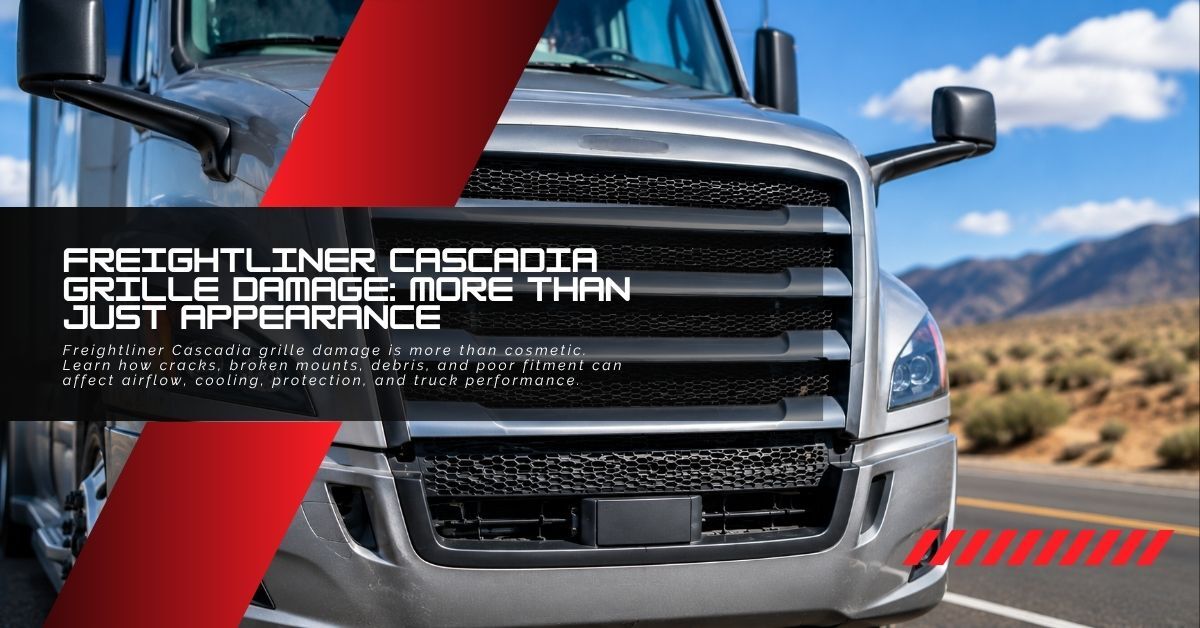
Why Freightliner Cascadia Grille Damage Is More Than Just Appearance
A cracked, bent, or damaged grille on a Freightliner Cascadia may seem like an appearance problem that can wait until your next major repair.
But the grille does considerably more than make the front of your truck look complete.
It sits directly in the path of highway airflow and helps protect important components behind the front end. When the grille becomes cracked, loose, obstructed, or badly misaligned, the problem can potentially affect airflow, expose components to road debris, create vibration, and contribute to additional front-end damage.
For owner-operators and fleets putting thousands of miles on their trucks every month, damaged exterior components deserve the same attention as other frequently inspected semi truck parts.
Here's what Freightliner Cascadia owners should know.
What Does the Freightliner Cascadia Grille Actually Do?
The grille is one part of a larger front-end system.
The Cascadia's grille, bumper, hood, air openings, and surrounding panels work together to manage airflow while providing protection for components located behind them.
The grille helps:
- Allow outside air into the front of the truck
- Support airflow toward cooling components
- Protect components from larger road debris
- Maintain the intended front-end configuration
- Contribute to the truck's aerodynamic design
- Complete the structural and visual appearance of the front end
This means damage shouldn't automatically be dismissed because the truck can still be driven.
1. Cracks Can Become Larger With Highway Vibration
A small grille crack may remain relatively unnoticed while the truck is parked.
Highway operation is different.
Commercial trucks experience constant vibration from the engine, road surface, suspension movement, potholes, bridge joints, and changing aerodynamic loads.
Once a grille develops a crack, repeated vibration can cause that damaged area to spread.
Eventually, you may experience:
- Larger cracks
- Loose grille sections
- Broken mounting points
- Rattling
- Panel movement
- Pieces separating from the grille
Catching minor damage early can help prevent a relatively straightforward replacement from becoming a larger front-end repair.
2. Broken Mounting Points Can Cause Grille Movement
Sometimes the grille itself isn't severely damaged, but the mounting points are.
Broken clips, brackets, fasteners, or mounting tabs can allow the grille to move while driving.
Signs can include:
- Rattling at certain speeds
- Visible grille movement
- Uneven panel gaps
- A grille that sits differently on one side
- Increasing wind noise
- Repeatedly loose fasteners
Movement becomes particularly important at highway speeds because aerodynamic pressure increases as the truck travels faster.
A grille that seems secure in the yard may behave very differently at interstate speeds.
3. Grille Damage Can Affect Airflow
One reason the front end of a modern semi truck matters is airflow.
Your engine's cooling system relies on coolant circulation and sufficient airflow through heat-exchange components.
The front of the Freightliner Cascadia is engineered to allow air to travel through designated openings rather than simply hitting the truck randomly.
A severely damaged, displaced, or obstructed grille may alter that airflow.
Problems become particularly important when the truck is operating under demanding conditions such as:
- Hot weather
- Heavy loads
- Long climbs
- Stop-and-go operation
- Extended highway driving
Grille damage alone isn't necessarily the cause whenever a Cascadia runs hot. Cooling problems can involve the radiator, coolant, thermostat, fan clutch, water pump, hoses, or other components.
But when diagnosing unusual operating temperatures, front-end airflow shouldn't be ignored.
4. Road Debris Can Damage More Than the Grille
The grille also provides a first layer of protection against debris encountered on the highway.
A semi truck can encounter:
- Gravel
- Stones
- Tire fragments
- Construction debris
- Bugs
- Branches
- Loose cargo debris
A damaged grille with missing sections may provide less protection for components positioned farther inside the front end.
That's one reason a broken grille can become more than a cosmetic concern.
Replacing damaged exterior Freightliner Cascadia parts can help restore the protection and fitment intended for the front of the truck.
5. Front-End Damage Can Affect Multiple Components
If grille damage resulted from a collision or impact, don't assume the grille is the only affected component.
Inspect the surrounding area.
Pay particular attention to:
- Bumper alignment
- Hood alignment
- Headlights
- Mounting brackets
- Air openings
- Nearby body panels
- Fasteners and supports
An impact strong enough to crack or displace a grille may also shift components around it.
This is especially relevant to the Freightliner Cascadia bumper because the bumper and grille occupy the same critical front-end airflow area.
6. A Damaged Bumper and Grille Can Create a Bigger Airflow Problem
One damaged component may not dramatically change the way your truck operates.
Multiple misaligned front-end components are more concerning.
Suppose the grille is damaged while the bumper is also cracked, displaced, or improperly fitted. The overall airflow path at the front of the truck may differ more significantly from its intended configuration.
We've explored this relationship in Can a Damaged Freightliner Cascadia Bumper Affect Cooling?.
That article explains why the bumper shouldn't automatically be viewed as cosmetic. The same principle applies to the grille: modern truck front ends are designed as interconnected systems.
7. Poor Grille Fitment Can Be Almost as Problematic as Damage
Replacing a damaged grille doesn't automatically solve the problem if the replacement doesn't fit properly.
Poor fitment can result in:
- Uneven panel gaps
- Loose mounting points
- Vibration
- Rattling
- Improper alignment
- Unnecessary stress on surrounding components
Before ordering replacement semi truck parts, verify the truck's model and year and confirm that the component is intended for the correct application.
Proper fitment matters whether you're purchasing OEM or aftermarket components.
8. Grille Damage Can Increase Noise and Vibration
A loose grille can create sounds that are difficult to identify from inside the cab.
Drivers may notice:
- Buzzing
- Rattling
- Whistling
- Intermittent vibration
The noise may become more pronounced at certain speeds because airflow changes as vehicle speed increases.
This is similar to other exterior problems we've discussed with Volvo trucks. For example, our guide Why Does My Volvo VNL Mirror Shake While Driving? explains how minor mounting issues can become much more noticeable once wind pressure and highway vibration increase.
The truck model and component are different, but the maintenance principle is the same: exterior vibration shouldn't automatically be ignored.
Signs Your Freightliner Cascadia Grille Needs Attention
Inspect your grille if you notice:
- Visible cracks
- Missing grille sections
- Broken mounting tabs
- Loose fasteners
- Uneven alignment
- Excessive movement
- Rattling at highway speeds
- Damage after a front-end impact
- Debris lodged in airflow openings
You should also inspect it whenever you're checking the bumper, headlights, or hood after front-end damage.
Should You Repair or Replace a Damaged Freightliner Cascadia Grille?
The answer depends on the severity and location of the damage.
Minor cosmetic damage that doesn't compromise mounting points or structural integrity may not require immediate replacement.
Replacement becomes more appropriate when:
- Mounting points are broken
- Large sections are cracked
- Pieces are missing
- The grille won't remain securely mounted
- Damage affects alignment
- Previous repairs continue failing
- The grille no longer provides adequate protection
For commercial trucks, durability and secure fitment should generally matter more than temporarily improving appearance.
OEM vs. Aftermarket Freightliner Cascadia Parts
Truck owners frequently assume OEM is their only choice when replacing exterior components.
It isn't.
Quality aftermarket Freightliner Cascadia parts can provide an alternative for owner-operators, repair shops, and fleets looking to control maintenance costs.
When evaluating an aftermarket grille or another exterior component, consider:
- Application
- Model year compatibility
- Construction quality
- Mounting design
- Fitment
- Supplier reliability
The goal isn't simply to find the cheapest replacement. It's to find the right component at a sensible cost.
Why Aftermarket Freightliner Parts Can Make Sense for Fleets
The economics become particularly important when managing multiple trucks.
Fleet managers have to balance:
- Parts costs
- Vehicle downtime
- Inventory availability
- Repair schedules
- Fitment
- Service life
A single expensive component may not significantly affect a fleet's annual maintenance budget. Repeating that premium across dozens or hundreds of trucks can.
Quality aftermarket replacement parts give fleets another option for keeping trucks operational without automatically purchasing every exterior component through an OEM channel.
How Often Should You Inspect the Grille?
You don't need to wait for a scheduled major service.
A quick visual inspection can be incorporated into routine walkarounds.
Look for changes such as:
- New cracks
- Loose sections
- Missing hardware
- Impact marks
- Unusual alignment
- Debris accumulation
Pay particular attention after driving through construction zones, severe weather, or roads where debris is common.
Don't Forget the Rest of the Freightliner Cascadia Front End
If you've found grille damage, use the opportunity to inspect other nearby components.
Bumper
Check for cracks, impact damage, sagging, and mounting problems. QSC Truck Parts carries Freightliner Cascadia bumpers for compatible applications.
Headlights
Confirm that housings remain securely mounted and properly aligned.
Hood
Look for unusual gaps or signs that an impact has shifted the hood.
Cooling Openings
Remove leaves, debris, or other material restricting airflow.
Mounting Hardware
Inspect clips, bolts, brackets, and fasteners throughout the damaged area.
Looking at the front end as a complete system can reveal problems that aren't obvious when inspecting only one component.
Frequently Asked Questions
Can a damaged Freightliner Cascadia grille cause overheating?
Severe damage, displacement, or obstruction can interfere with front-end airflow, which may contribute to reduced cooling efficiency. However, overheating can have many mechanical causes, so the entire cooling system should be evaluated rather than assuming the grille is responsible.
Is a cracked Freightliner Cascadia grille only cosmetic?
Not necessarily. A minor surface crack may initially be cosmetic, but cracks can spread and damaged mounting points can allow the grille to loosen or move.
Should I replace a grille with broken mounting tabs?
If broken mounting points prevent the grille from being securely installed and properly aligned, replacement is generally the better long-term solution.
Can a damaged bumper affect the grille?
Yes. Front-end impacts can affect several adjacent components simultaneously. If your bumper is damaged, inspect the grille, hood, lights, brackets, and surrounding panels.
Are aftermarket Freightliner Cascadia parts reliable?
Quality aftermarket parts can provide dependable performance when they're designed for the correct model, year, and application. Correct fitment and manufacturing quality are more important than simply choosing a part because it's inexpensive.
Where can I find Freightliner Cascadia parts?
QSC Truck Parts offers Freightliner Cascadia parts for owner-operators, fleets, and repair facilities looking for aftermarket replacement components.
Find Freightliner Cascadia Parts at QSC Truck Parts
A damaged grille may look like a cosmetic problem, but ignoring significant cracks, broken mounts, missing sections, or poor alignment can lead to additional problems.
Your truck's front end works as a system. The grille, bumper, hood, lighting, and other exterior components help protect the truck while supporting proper fitment and airflow.
QSC Truck Parts provides aftermarket Freightliner Cascadia parts and other semi truck parts for commercial truck applications.
If your front end has been damaged, don't inspect only what you can see at first glance. Check the grille, bumper, mounting hardware, surrounding panels, and airflow openings together. Addressing relatively small problems early can help prevent them from becoming more expensive repairs later.
