
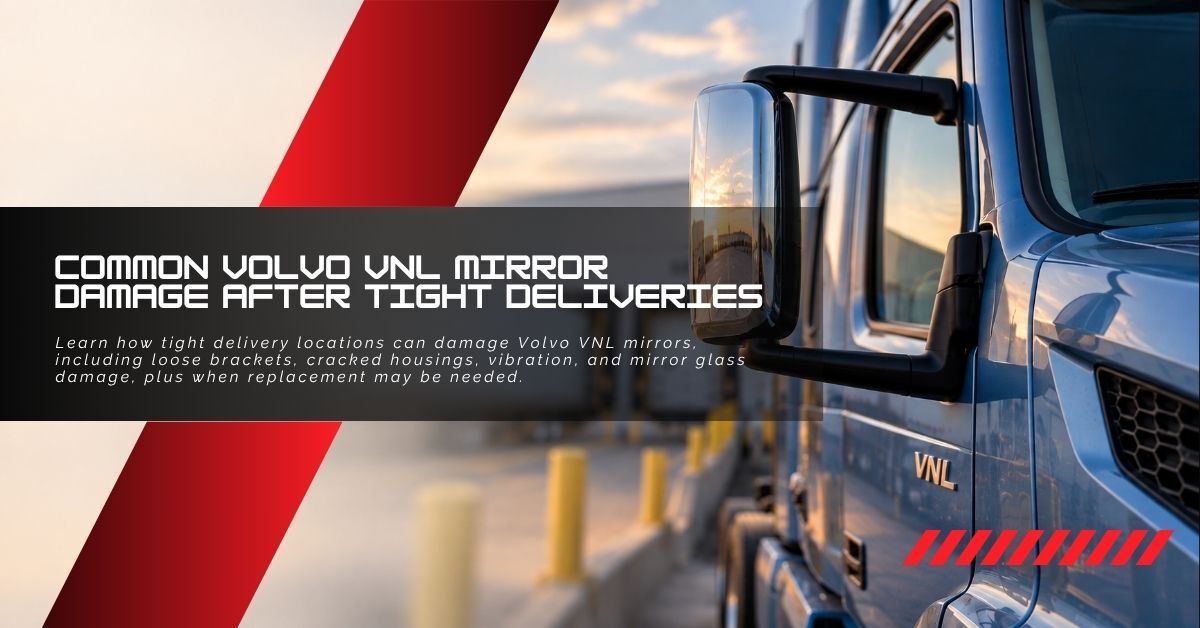
A Volvo VNL can spend most of its working life on open highways, but some of the most frustrating exterior damage happens during the final few hundred feet of a delivery.
Distribution centers, loading docks, warehouses, construction sites, older commercial properties, and congested delivery areas can leave drivers with very little room to maneuver. A truck may have to back between obstacles, squeeze alongside buildings, or turn through an area that was never designed with a modern Class 8 truck in mind.
The mirrors are particularly vulnerable.
A light impact that doesn't appear serious can loosen a mirror assembly, damage a bracket, crack the housing, or create vibration that becomes much more noticeable once the truck returns to highway speeds.
For drivers and fleets maintaining Volvo trucks, recognizing mirror damage early can prevent a relatively small problem from becoming a complete mirror replacement.
Here's what to inspect after a tight delivery and how to determine when it's time to start looking for replacement Volvo VNL parts.
Why Volvo VNL Mirrors Are Vulnerable During Tight Deliveries
Mirrors extend beyond the main body of the cab because drivers need a clear view alongside the truck and trailer.
That positioning is essential for visibility, but it also puts the mirror assembly closer to obstacles such as:
- Dock structures
- Building columns
- Gates
- Fences
- Tree branches
- Parked vehicles
- Other trailers
- Warehouse walls
- Signs and posts
Drivers can also encounter situations where the tractor clears an obstacle but the mirror doesn't.
The result doesn't always look dramatic.
Sometimes the mirror folds or moves and appears fine afterward. But an impact can still affect the mounting hardware, housing, bracket, adjustment mechanism, or glass.
1. Loose Volvo VNL Mirror Mounts
One of the first things to check after a minor mirror impact is the mounting area.
Even when the mirror housing doesn't crack, an impact can loosen the hardware holding the assembly in place.
Possible signs include:
- Movement at the mirror base
- New rattling
- Increased vibration
- A mirror that won't stay in position
- Changes in alignment
- Visible gaps around mounting points
A loose mount is especially noticeable once the truck returns to highway speeds.
Wind pressure that seemed insignificant around a loading dock becomes much stronger at 60 or 70 mph.
If your mirror begins shaking after an impact, our guide Why Does My Volvo VNL Mirror Shake While Driving? covers the most common causes of Volvo VNL mirror vibration and what should be inspected.
2. Cracked Mirror Housings
The housing is another common impact point.
A mirror may scrape against a wall, post, trailer, or other obstacle without completely breaking away from the truck.
Look closely for:
- Hairline cracks
- Split seams
- Scrapes around impact areas
- Loose housing sections
- Missing pieces
- Separation around mounting locations
A small crack may seem cosmetic initially.
However, commercial trucks experience continuous vibration. Repeated highway operation can cause an existing crack to spread, particularly if the impact also weakened a mounting point.
Water and road contamination can also enter damaged areas and affect components inside the assembly.
3. Broken or Weakened Mirror Brackets
The mirror itself isn't always the component that absorbs the entire impact.
The bracket supporting it may bend, crack, or loosen.
A damaged bracket can cause the mirror to sit differently than it did before the delivery.
Compare both sides of the truck and look for:
- Different mirror angles
- Uneven positioning
- Bent supports
- Cracks near mounting points
- Excessive movement
- Difficulty keeping the mirror adjusted
Bracket damage deserves attention because the bracket supports the entire assembly.
A damaged support that continues flexing can eventually place additional stress on the mirror housing and mounting hardware.
4. Mirror Glass Damage
Mirror glass can be damaged even when the outer housing appears relatively intact.
Common problems include:
- Cracks
- Chips
- Scratches
- Distortion
- Loose glass
- Glass separating from its backing
Visibility is the primary concern.
A commercial truck driver relies heavily on mirrors when changing lanes, merging, backing, and positioning a trailer.
Even relatively small damage can become distracting if it falls within an important viewing area.
If the glass moves or vibrates independently from the housing, the internal mounting mechanism should also be inspected.
5. Mirror Vibration That Appears Only at Highway Speeds
This is one of the easiest problems to miss.
A driver bumps a mirror while making a delivery, checks it afterward, and everything appears normal.
Then the truck reaches highway speed.
Suddenly the mirror begins vibrating.
Why?
The impact may have introduced a small amount of looseness that isn't obvious while parked. At highway speeds, airflow continuously loads the mirror assembly.
That can expose:
- Loose hardware
- Damaged brackets
- Worn mounting points
- Cracked housings
- Internal mirror movement
Don't assume a newly shaking mirror is simply normal vibration.
If the problem started immediately after a tight delivery or minor impact, inspect the assembly before the looseness becomes worse.
6. Damage to the Adjustment Mechanism
Modern truck mirrors may include powered adjustment and other integrated functions depending on configuration.
An impact can sometimes affect the internal mechanism without producing obvious external damage.
Possible symptoms include:
- Mirror won't adjust through its full range
- Adjustment is slower than normal
- Glass moves unexpectedly
- Mirror won't hold its selected position
- One direction of adjustment stops working
If adjustment problems begin immediately after an impact, don't assume the switch is responsible.
Inspect the mirror assembly and related connections first.
7. Wiring and Connector Damage
Exterior mirrors can contain electrical connections for functions such as adjustment, heating, lighting, or other equipment depending on the specific truck and mirror configuration.
An impact that shifts the housing or mounting area can potentially affect those connections.
Watch for functions that worked before the delivery but suddenly stop afterward.
When inspecting the mirror, check for:
- Pinched wiring
- Pulled connectors
- Damaged insulation
- Loose electrical connections
- Moisture entering damaged housing areas
This is another reason apparently minor exterior damage shouldn't automatically be dismissed as cosmetic.
8. Mirror Housing Misalignment
Sometimes nothing is obviously broken, but the assembly no longer sits correctly.
Misalignment can happen when a bracket or mounting area is slightly bent during contact with an obstacle.
The driver may find that the mirror needs to be adjusted much farther than usual to achieve the same view.
You may also notice that the mirror doesn't match the position of the opposite side.
This can indicate that something beneath the visible housing has shifted.
Why Small Mirror Damage Can Become Expensive
The temptation after a minor impact is to leave the mirror alone as long as it remains usable.
Sometimes that's reasonable.
But the problem should still be monitored.
A loose mounting point can create vibration.
Vibration can increase stress on the bracket.
The bracket can allow additional housing movement.
The housing or mounting tabs can eventually crack.
Now several components may need attention instead of one.
This is a common pattern with exterior Volvo truck parts. Problems that appear cosmetic can become functional once vibration, highway airflow, and thousands of additional miles are added to the equation.
What Should Drivers Inspect Immediately After Mirror Contact?
If your Volvo VNL mirror hits something during a delivery, don't just check whether the glass is still there.
Perform a quick inspection before returning to normal operation.
Check the Glass
Look for cracks, chips, movement, and distortion.
Move the Housing Carefully
Determine whether the assembly has more movement than it did previously.
Inspect the Mounting Area
Look for loose hardware, cracked mounting points, or gaps.
Check the Bracket
Look for bending, cracking, or a change in position.
Test Adjustment
Confirm that the mirror still adjusts normally and remains in position.
Test Electrical Functions
If the mirror has powered or heated functions, confirm they continue working.
Look at Alignment
Compare the assembly with its normal position and, where useful, with the opposite mirror.
A two-minute inspection can reveal a problem before another several hundred miles of highway vibration make it worse.
Repair or Replace a Damaged Volvo VNL Mirror?
Whether repair or replacement makes sense depends on what was damaged.
A minor adjustment may be enough when hardware simply loosened and the housing, bracket, and mounting points remain intact.
Replacement becomes more appropriate when:
- The housing is significantly cracked
- Mounting points are broken
- The bracket is bent or damaged
- Mirror glass is severely damaged
- The assembly won't remain adjusted
- Vibration continues after hardware is checked
- Electrical functions have been damaged
- Previous repairs continue failing
When comparing replacement Volvo VNL parts, verify compatibility with the specific truck before ordering.
Why Correct Fitment Matters With Aftermarket Volvo VNL Parts
Aftermarket components can provide owner-operators and fleets with a cost-effective alternative when replacing damaged exterior truck parts.
But fitment matters.
The correct mirror assembly or related component should match the appropriate Volvo VNL application and configuration.
Before ordering aftermarket Volvo truck parts, verify:
- Truck model
- Model year
- Driver or passenger side
- Mounting configuration
- Electrical connections
- Mirror functions
- Relevant product specifications
A mirror that looks similar isn't necessarily the correct replacement.
Proper fitment helps reduce installation problems and ensures the assembly sits securely where intended.
Fleet Trucks Face an Even Greater Risk of Delivery Damage
Mirror damage isn't limited to inexperienced drivers.
Fleet vehicles may visit hundreds of different facilities over their service lives, and every delivery environment is different.
Some locations provide large loading areas designed for tractor-trailers.
Others require drivers to negotiate narrow entrances, crowded yards, parked vehicles, tight docks, and poorly positioned obstacles.
The risk accumulates.
For fleets operating multiple Volvo VNL trucks, it makes sense to track recurring exterior damage and determine which Volvo VNL aftermarket parts are replaced most frequently.
That can help maintenance departments plan inventory and reduce downtime when another mirror or exterior component is damaged.
Don't Ignore Other Exterior Damage After a Tight Delivery
If the truck contacted an obstacle, inspect more than the mirror.
Depending on where the contact occurred, you may also need to look at:
- Fairings
- Fairing brackets
- Cab panels
- Steps
- Lighting
- Bumper corners
- Fenders
- Other mounting hardware
For example, aerodynamic components can experience similar problems with looseness and broken mounting points. Our guide 7 Signs Your Volvo VNL Wind Cab Fairing Brackets Need Replacement explains what to watch for when those supports begin failing.
Aftermarket Parts Can Make Fleet Repairs More Practical
Exterior damage is an unavoidable part of operating commercial vehicles.
For fleets, the costs become significant because the same types of repairs may occur repeatedly across multiple trucks.
Quality aftermarket replacement parts can give fleet managers another option for controlling those expenses.
This is especially relevant for trucks with higher mileage where paying a premium for every exterior replacement may not make financial sense.
The objective isn't simply to buy the least expensive component.
Fleet managers should consider:
- Fitment
- Construction
- Availability
- Installation
- Expected service life
- Downtime
- Total replacement cost
For a broader look at the subject, OEM vs. Aftermarket Volvo VNL Wind Cab Fairing Brackets: What's the Difference? discusses some of the factors fleets consider when choosing aftermarket Volvo VNL exterior components.
Frequently Asked Questions
Why does my Volvo VNL mirror shake after hitting something?
An impact can loosen mounting hardware, damage a bracket, crack the housing, or affect internal mirror components. The looseness may become much more noticeable at highway speeds because of increased wind pressure.
Can a loose Volvo VNL mirror be repaired?
Sometimes. If the problem is limited to loose hardware and the bracket, housing, and mounting points remain undamaged, securing the assembly may solve the problem. Broken mounting points or structural damage may require replacement.
Should I replace a cracked Volvo VNL mirror housing?
Replacement becomes more appropriate when the crack affects structural integrity, continues spreading, allows significant movement, or compromises the mounting system.
Why is my Volvo VNL mirror fine when parked but shakes on the highway?
Highway airflow places considerably more pressure on the mirror assembly. Small amounts of looseness that aren't obvious while parked can become noticeable at higher speeds.
Are aftermarket Volvo VNL mirrors a good option?
A quality aftermarket replacement can be a practical option when it is designed for the correct Volvo VNL application and provides appropriate fitment and functionality.
What information do I need before ordering Volvo VNL mirror parts?
Verify your model year, mirror side, mounting configuration, electrical connections, and required mirror functions before ordering replacement Volvo VNL parts.
Catch Volvo VNL Mirror Damage Before It Gets Worse
Tight delivery locations are part of commercial trucking.
Even an experienced driver can eventually encounter a dock, post, wall, gate, branch, or other obstacle that's just a little too close to the mirror.
The important part is what happens afterward.
Don't judge mirror damage solely by whether the glass survived the impact. Check the housing, bracket, mounting hardware, alignment, adjustment mechanism, and electrical functions.
Then pay attention to how the mirror behaves once the truck returns to highway speeds.
New vibration is often a sign that something changed.
Addressing loose or damaged components early can help prevent additional damage, preserve driver visibility, and reduce the likelihood of a more expensive repair later.
When replacement is necessary, QSC Truck Parts offers Volvo VNL parts and Volvo truck parts for owner-operators, repair facilities, and fleets looking for aftermarket replacement options.
For more troubleshooting help, read Why Does My Volvo VNL Mirror Shake While Driving? to learn what can cause mirror vibration and which areas of the assembly deserve closer inspection.
